Bronx Criminal Defense Attorney David Colgan Explains How Criminal Obstruction of Breathing Is Charged Under NY Penal Law § 121.11
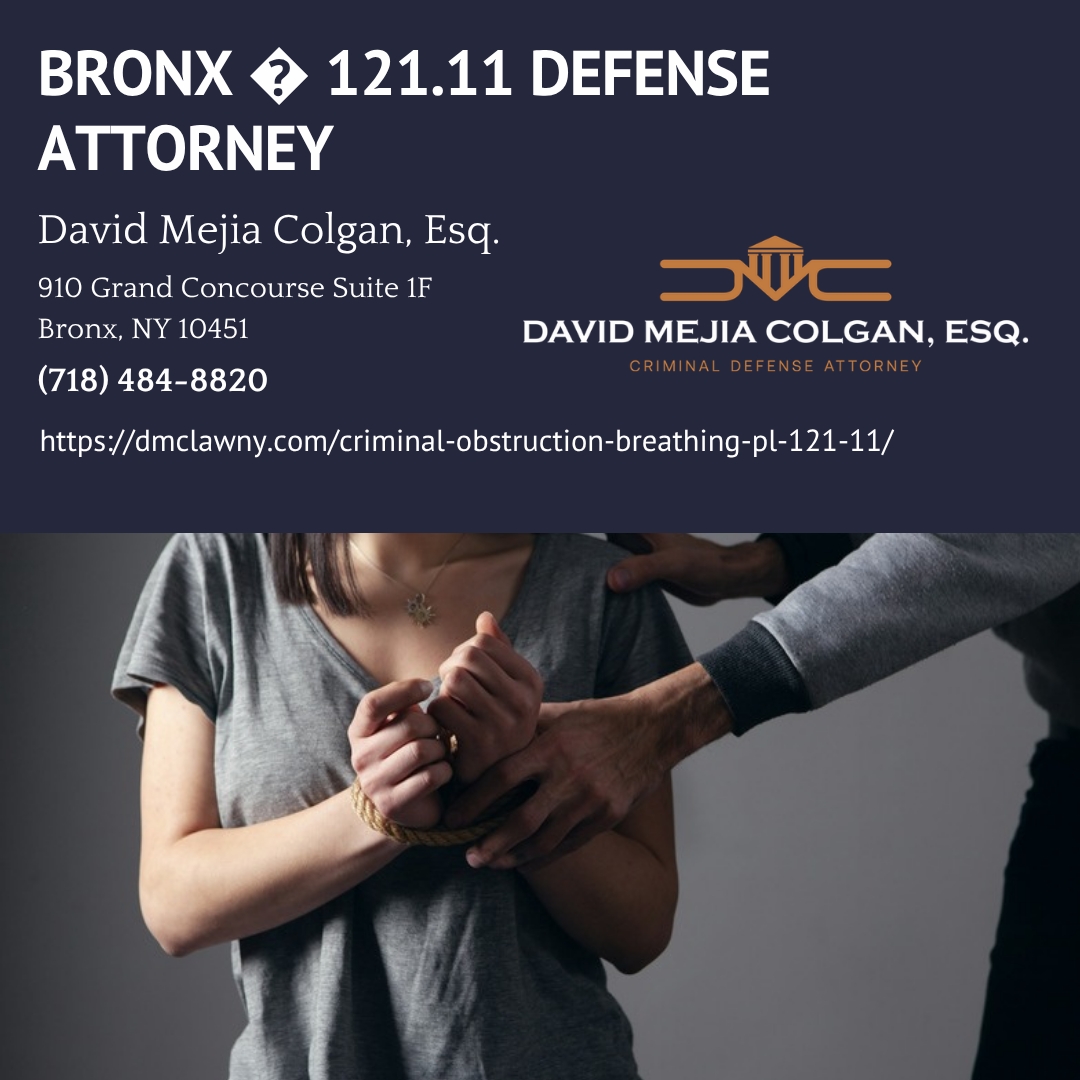
BRONX, NY – Criminal obstruction of breathing under New York Penal Law § 121.11 is classified as a misdemeanor but carries consequences far more serious than the misdemeanor label suggests, including potential immigration removal, a federal firearm prohibition, and disruption to housing and family life. Bronx criminal defense attorney David Mejia Colgan of David Mejia Colgan, Esq. (https://dmclawny.com/criminal-obstruction-breathing-pl-121-11/) explains how the Bronx District Attorney’s Office builds these cases and what defendants should know after an arrest.
According to Bronx criminal defense attorney David Mejia Colgan, PL § 121.11 makes it a Class A misdemeanor to apply pressure to a person’s throat or neck, or block their nose or mouth, with the specific intent to impede normal breathing or blood circulation. The statute does not require proof of physical injury. “The law criminalizes the act itself, not the result,” Colgan explains. “Even when no marks, bruises, or medical findings are present, the charge can still stand if prosecutors can prove the required intent.”
Bronx criminal defense attorney David Mejia Colgan notes that a § 121.11 conviction carries a maximum sentence of 364 days in jail, a probation term of two or three years, and a fine of up to $1,000. The charge does not always remain at the misdemeanor level. If prosecutors allege the obstruction caused stupor, loss of consciousness for any period, or other physical injury, they may seek a felony strangulation charge under PL § 121.12, a Class D felony carrying up to 7 years in state prison, or PL § 121.13, a Class C felony carrying up to 15 years.
Attorney Colgan adds that the Bronx DA’s Office treats § 121.11 as a domestic violence offense whenever the accused and the complainant are intimate partners, family members, or members of the same household. Under Criminal Procedure Law § 140.10, police are required to make an arrest when they have reasonable cause to believe a felony family offense has occurred, and mandatory arrest also applies to misdemeanor family offenses absent the primary-aggressor or justification exceptions. At arraignment, the court may issue a temporary order of protection that can require the defendant to leave a shared home and have no contact with the complainant.
The firm also handles cases where the complainant later recants or refuses to participate. Attorney Colgan points out that the Bronx DA’s Domestic Violence Bureau routinely prosecutes § 121.11 charges using prior statements, qualifying 911 recordings, medical records, and witness testimony, even without the complainant’s cooperation. Under the framework established in Crawford v. Washington, testimonial statements generally require cross-examination, but some 911 statements may be treated as non-testimonial when their primary purpose is to address an ongoing emergency.
Colgan emphasizes that intent is often the most contested element in these cases. “Accidental contact during a mutual struggle does not satisfy the statute,” he observes. “The prosecution must prove the defendant specifically intended to restrict breathing or blood flow. Where the contact occurred while trying to calm someone down, or during a chaotic incident with no specific intent, the legal element is missing.” Other defenses include false allegations motivated by custody or housing disputes, self-defense under Penal Law Article 35 when proportional and the accused was not the initial aggressor, and motions to dismiss when the accusatory instrument lacks sufficient factual detail.
The collateral consequences of a § 121.11 conviction often extend well beyond any jail sentence. A qualifying misdemeanor crime of domestic violence triggers a federal firearms prohibition under 18 U.S.C. § 922(g)(9). Non-citizen defendants may face removal proceedings or disqualification from naturalization and other immigration benefits. A conviction can also affect custody and visitation determinations in New York courts and create lasting barriers to employment, professional licensing, and housing.
Attorney Colgan represents clients in Bronx Criminal Court and Bronx Supreme Court from his office at 910 Grand Concourse, Suite 1F. The firm handles arraignments, contested orders of protection, suppression motions, plea negotiations, and trials on charges prosecuted by the Bronx DA’s Domestic Violence Bureau.
For those facing a criminal obstruction of breathing charge in the Bronx, contacting an experienced criminal defense attorney early may help challenge the prosecution’s evidence, contest the conditions of an order of protection, and prevent the charge from being upgraded to a felony strangulation count.
About David Mejia Colgan, Esq.:
David Mejia Colgan, Esq. is a Bronx-based criminal defense practice focused on representing individuals charged with violent crimes and domestic violence offenses. A former Assistant District Attorney in the Bronx County District Attorney’s Office, attorney David Mejia Colgan brings more than 30 years of criminal law experience to clients throughout the Bronx, Riverdale, and surrounding boroughs. The office is located at 910 Grand Concourse, Suite 1F. For consultations, call (718) 484-8820.
Embeds:
Youtube Video: https://www.youtube.com/watch?v=84ak1_E3l6k
GMB: https://www.google.com/maps?cid=10458568621536558650
Email and website
Email: [email protected]
Website: https://dmclawny.com/
Media Contact
Company Name: David Mejia Colgan, Esq.
Contact Person: David Mejia Colgan
Email: Send Email
Phone: (718) 484-8820
Address:910 Grand Concourse Suite 1F
City: Bronx
State: NY 10451
Country: United States
Website: https://dmclawny.com/


