New Cosmology Book Challenges Science’s Biggest Assumptions, Proposing the Big Bang is Still Happening Today
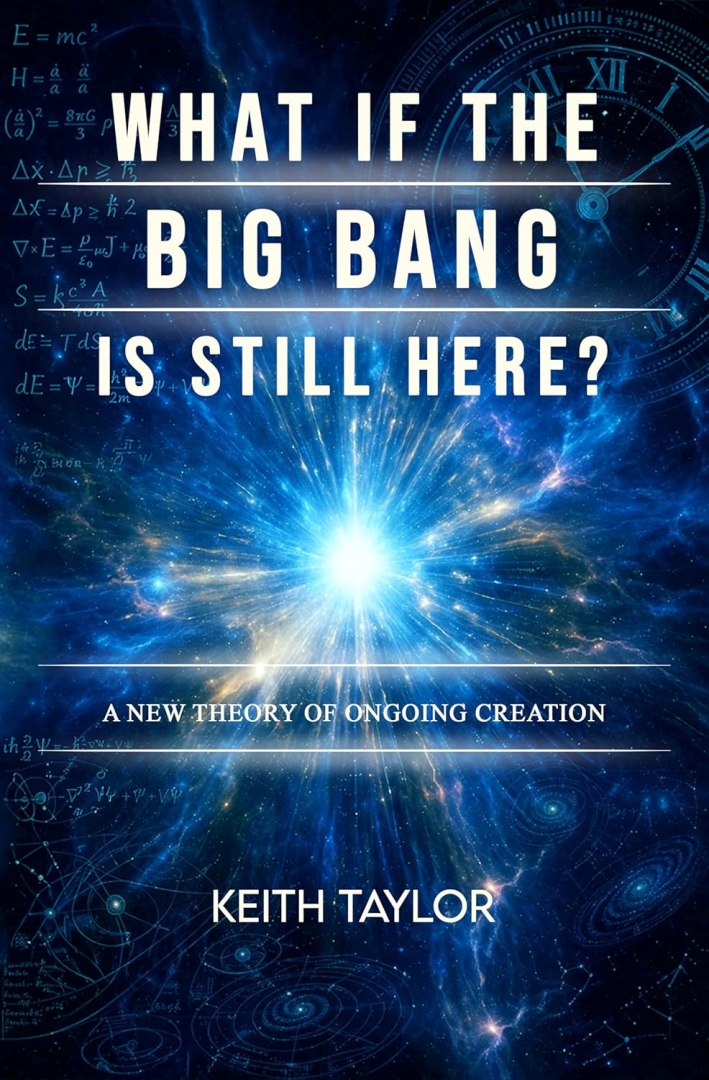
What if the universe never stopped being created? What if the Big Bang wasn’t simply an event locked away in the distant past but part of a process still unfolding today?
Keith Taylor asks these questions in his upcoming book, What if the Big Bang is Still Here? A New Theory of Ongoing Creation. It’s scheduled for release soon, and the whole thing is meant to be a bit thought-provoking, like really. In it, he lays out the Void Energy-Regulated Space Framework (VERSF), which is an original theoretical model that, honestly, sidesteps a lot of familiar ways people talk about reality, while also pushing curiosity, back-and-forth discussion and further exploring.
Instead of just rehashing older scientific theories, Taylor brings forward a fresh angle that ties information, entropy, resonance, and the basic nature of existence together in one integrated frame. The book is written in plain terms for readers who want to know more but don’t necessarily have a physics background. So it’s basically an invitation to challenge long-held assumptions, and try to picture what the universe might look like, if the foundations everyone leans on have been misunderstood the whole time.
A Different Way to Think About Reality
Many scientific books explain how the universe works by leaning on models that are already around. In this one it starts with a kind of awkward question, like do those same models leave some important things still hanging in the air.
Taylor brings you into a universe that feels less like a machine running on fixed rules, and more like a living process that keeps organizing itself, almost in the background. With the VERSF framework, things such as time, gravity, matter, and even consciousness do not just sit there as separate independent ingredients of reality. Instead, they show up from deeper informational dynamics, as if the “how” comes first and the “what” follows.
Without giving away the full theory, the book walks through themes that push against conventional habits, but it still stays with clear logic and mathematical development.
Each chapter sort of follows the previous one, but in a way that makes you look again at ideas you thought you already understood. By the end you’re invited to re-examine familiar concepts from a completely different angle, you know, the kind that makes you pause for a second.
Questions That Continue Long After the Last Page
Instead of giving straightforward answers, What if the Big Bang is Still Here? kinda pushes readers to wrestle a bit with a bunch of science’s more enthralling puzzles, not neatly lined up or anything. Among the questions explored are:
➔ What if time is a consequence of change, not the other way around?
➔ Could gravity show up without needing space time curvature?
➔ Is the cosmos put together using information first, before matter and energy?
➔ Might dark matter and dark energy be hiding other, plainer reasons?
➔ Can consciousness and physical reality end up sharing one underlying basis?
➔ And what does entropy actually do, in shaping everything from galaxies to life itself .
Written for Curious Minds, Not Just Scientists
Keith Taylor intentionally avoids overwhelming readers with technical language. While the ideas behind VERSF draw from mathematics and theoretical physics, the book explains them through clear examples, thoughtful analogies, and a conversational style that welcomes readers into the discussion.
This upcoming release will appeal to:
➔ Readers fascinated by cosmology, physics, and the origins of the universe.
➔ Science enthusiasts interested in alternative theoretical models.
➔ Philosophical thinkers who enjoy exploring the relationship between consciousness and reality.
➔ Students, educators, and lifelong learners looking for fresh perspectives on modern scientific questions.
➔ Anyone who enjoys books that challenge accepted ideas while encouraging independent thought.
A Theory Born from Questions That Became Personal
Behind every scientific idea is a person asking difficult questions.
For Keith Taylor, those questions got stronger during a stretch that was, honestly, marked by some very deep personal loss, including the passing of his parents, the sudden death of a close friend, and his own battle with cancer . In other words, it didn’t just hurt him, it changed how he started seeing time, existence, and even what the word reality really points to.
Instead of accepting the usual, familiar explanations, he went off and did years of independent research, and that work eventually turned into the VERSF framework. Along the way, he also used artificial intelligence as a research partner to stress-test logic, sharpen the reasoning, and check whether the model stayed coherent and consistent. The final outcome is a book where personal determination runs alongside a real wish to dig into unanswered scientific questions, not to pretend they’re settled already.
Early Reader Response
One pre launch reader described the manuscript as “the kind of book that stays with you after you’ve closed it. It doesn’t ask you to abandon science, it asks you to look at it from a different direction. I found myself thinking about time, space, and even everyday life in ways I never had before. Whether every idea proves correct or not, the conversations this book starts are worth having.”
That response reflects the spirit of the book itself. It invites discussion instead of demanding agreement, encouraging readers to participate in one of humanity’s oldest pursuits: understanding where we come from and how reality truly works.
About the Author
Keith Taylor is an independent researcher, whose work kind of roams around the overlap of theoretical physics, information theory, entropy, and cosmology. Instead of taking the usual academic road, he put together the Void Energy-Regulated Space Framework over years of personal inquiry, driven by curiosity and that persistent sort of patience.
A big part of his emphasis is that any new notion, whatever it is, should actually end up being tested by its internal logic, its forecasting power, and whether it can survive careful scrutiny. He also offers support for mathematical research connected to the VERSF framework through his research platform, so readers can dig into the theory in more depth, and kind of sit with it longer.
Availability
What if the Big Bang is Still Here? A New Theory of Ongoing Creation is scheduled for release soon in paperback and digital formats. Additional release details, purchasing information, and updates will be announced ahead of publication.
Media Contact
Company Name: The Empire Publishers (USA)
Contact Person: Iris Williams
State: Texas
Country: United States
Website: https://www.theempirepublishers.com/


